Why Did Pakistan Hockey Decline From World Champion to Struggling? The Real Reasons Behind the Downfall
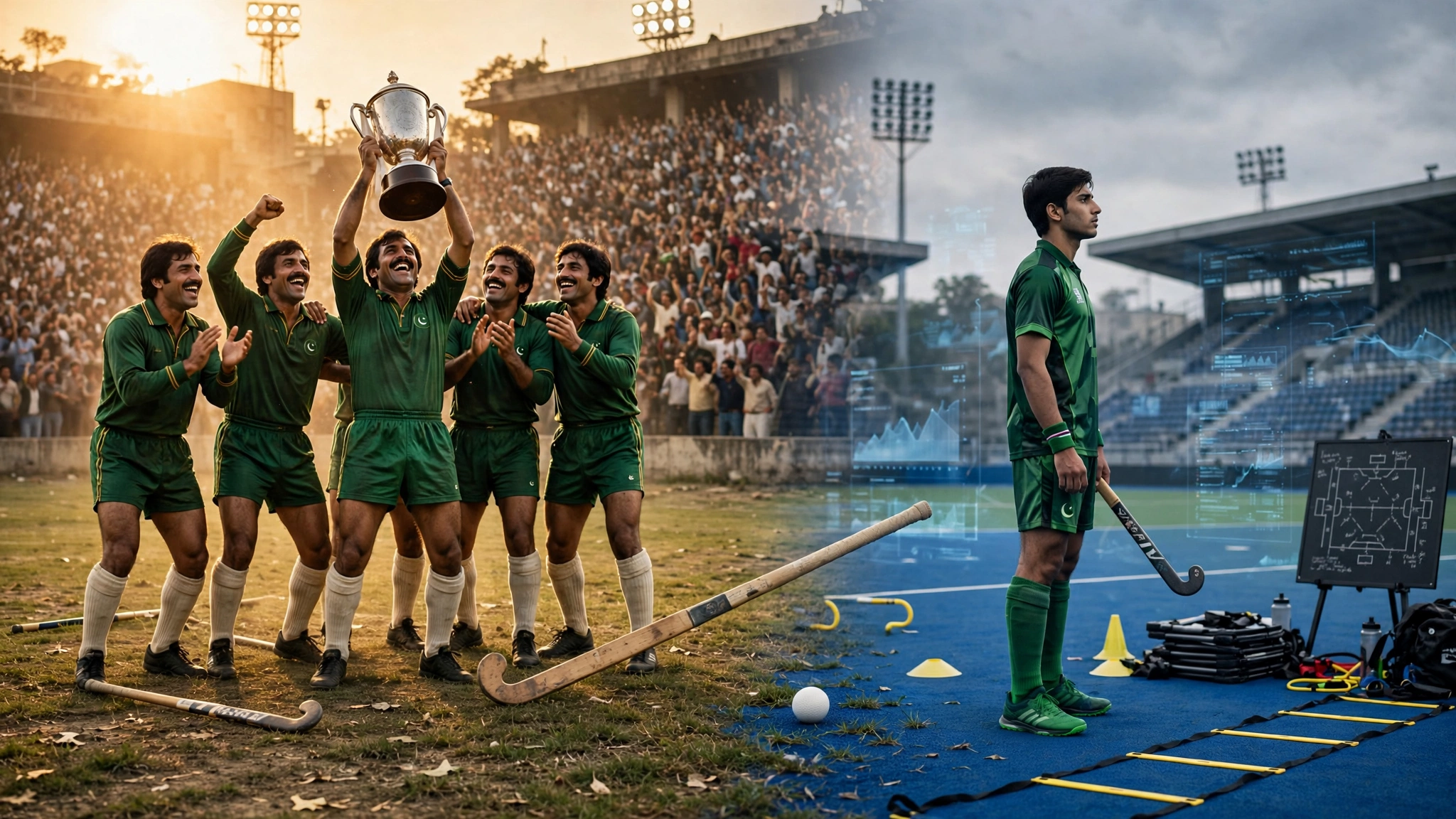
Pakistan was once one of the greatest hockey nations in the world. The country produced legendary players, won Olympic gold medals, became world champions and established a reputation for technically brilliant, attacking hockey.
Today, however, Pakistan hockey struggles to compete consistently at the highest international level.
So, what happened to Pakistan hockey?
The answer is much more complicated than simply blaming cricket, lack of funding or poor administration. The decline of Pakistan hockey has developed over decades and involves several interconnected problems: failure to adapt to artificial turf, weak grassroots development, the decline of departmental hockey, inconsistent coaching, inadequate sports science, governance problems and a lack of long-term planning.
The most important point is this:
«Pakistan did not suddenly lose its hockey talent. It lost the system that turned talented players into world champions.»
Pakistan Hockey's Golden Era
Pakistan's hockey history is filled with extraordinary achievements.
The country became a dominant force in international hockey and produced legendary players whose skills became part of hockey folklore. Pakistan's success was built on a combination of natural talent, technical ability, competitive domestic hockey and a strong institutional structure.
For generations, talented youngsters could progress through schools, colleges, clubs and departmental teams before reaching the national side.
This created a continuous pipeline of players.
But international hockey did not remain the same.
And that is where Pakistan's problems began to become increasingly visible.
1. Artificial Turf Changed Hockey Forever
One of the biggest reasons behind the decline of Pakistan hockey was the transformation of the game from traditional grass hockey to artificial turf hockey.
Artificial turf did not simply provide a different surface. It changed the technical and physical demands of the sport.
Modern turf hockey became:
- Faster
- More physically demanding
- More dependent on quick passing
- More tactically structured
- More reliant on acceleration and agility
- Less forgiving of poor first touches
- More dependent on organized pressing and transitions
Pakistan had historically produced players famous for individual skill, dribbling and creativity.
Those qualities remained important, but modern international hockey increasingly required players to combine individual ability with speed, tactical discipline, physical conditioning and structured team play.
Pakistan did not adapt its entire development system quickly and consistently enough.
The problem, therefore, was not simply a lack of artificial-turf grounds.
The deeper problem was the failure to develop a generation of players specifically prepared for modern turf hockey.
2. The Collapse of Grassroots Hockey
A successful national team begins long before players enter international hockey.
Pakistan once had a much stronger grassroots pathway:
School hockey → College hockey → Clubs → Departments → National selection
This system helped identify talented youngsters and gave them opportunities to develop through competitive hockey.
As grassroots hockey weakened, the supply of high-quality players also declined.
This is one of the most important reasons why Pakistan has struggled to consistently reproduce the great players of previous generations.
A national team cannot remain world-class if the development system beneath it is failing.
3. The Decline of Departmental Hockey
The departmental system was particularly important to Pakistani hockey.
Departments provided players with employment while allowing them to continue playing competitive hockey.
This meant that talented players could see hockey as more than a hobby.
They could build a career around it.
When departmental hockey weakened, an important part of the player-development ecosystem disappeared.
The consequences were significant:
- Fewer stable career opportunities
- Less regular competitive hockey
- Reduced incentives for young players
- A weaker domestic talent pool
- Less competition for national-team selection
The decline of departmental hockey therefore affected Pakistan hockey far beyond individual teams.
It weakened the entire talent pipeline.
4. Pakistan Failed to Modernize Its Hockey System
Modern hockey is no longer based purely on natural talent.
Elite teams now use:
- Strength and conditioning
- Sports science
- Nutrition
- Recovery programs
- Video analysis
- Tactical data
- Specialized coaching
- Performance monitoring
- Penalty-corner specialists
The best players are developed systematically from a young age.
Pakistan continued to produce talented hockey players, but its overall high-performance system did not evolve at the same speed as the leading hockey nations.
This created an increasing gap between individual talent and international performance.
A player can possess extraordinary technical ability, but without modern physical preparation, tactical understanding and professional development, that talent may never reach its full potential.
5. Tactical Evolution Left Pakistan Behind
International hockey became increasingly tactical.
Teams learned to use sophisticated pressing systems, structured defensive formations and rapid transitions between defense and attack.
The modern game demands players who can make decisions within fractions of a second.
Pakistan's traditional attacking style was based heavily on technical skill and creativity.
But individual brilliance became less effective against teams that were physically stronger and tactically more organized.
Pakistan needed to preserve its traditional technical strengths while adding modern tactical discipline.
Instead, the transition was inconsistent.
6. Penalty Corners Became a Specialized Skill
Penalty corners became one of the most important scoring opportunities in international hockey.
Modern teams developed specialist drag-flickers, injection specialists, stoppers and defensive routines.
Successful teams also used extensive video analysis to study opponents' penalty-corner strategies.
Pakistan had historically produced outstanding penalty-corner specialists, but maintaining a consistent pipeline of elite specialists requires dedicated coaching and development.
This is another example of how modern hockey moved toward specialization while Pakistan's development system struggled to maintain the same depth.
7. Governance and Lack of Long-Term Planning
Another major factor in the Pakistan hockey downfall is governance.
Elite sport requires continuity.
Developing a world-class hockey player takes years, not months.
A serious national development plan should cover:
Talent identification → youth development → coaching → fitness → international exposure → senior selection.
Frequent administrative instability makes such long-term planning difficult.
When priorities change repeatedly, development programs can lose continuity.
This is why governance is not merely an administrative issue.
It directly affects what happens on the hockey field.
8. Is Cricket Responsible for Pakistan Hockey's Decline?
Cricket is often blamed for the decline of hockey because it dominates Pakistan's sporting attention.
There is some logic behind this argument.
Cricket attracts enormous audiences, sponsorship and commercial investment.
However, saying “cricket killed Pakistan hockey” is too simplistic.
Cricket did not prevent hockey administrators from developing grassroots programs, modern coaching systems or professional player pathways.
The deeper issue was that hockey failed to build a sustainable ecosystem capable of competing for athletes, sponsors and public attention.
A successful sport must create its own commercial and developmental structure.
Therefore, cricket may have increased the pressure on hockey, but it should not be considered the primary cause of the decline.
9. International Exposure Became Increasingly Important
Top-level players improve by playing against top-level opposition.
Regular international competition exposes players to different tactical systems, speeds and physical demands.
Pakistan's reduced consistency at the highest level meant fewer opportunities to develop through sustained competition against the world's best teams.
This can create a vicious cycle:
Less international competition → slower development → poorer results → reduced confidence and investment → even less competitiveness.
Breaking this cycle requires sustained international exposure rather than occasional tournaments.
10. The Biggest Problem Was System Failure
When all these factors are considered together, the decline becomes easier to understand.
It was not one bad coach.
It was not one federation president.
It was not simply a lack of money.
And it was not simply because of cricket.
Pakistan hockey gradually lost the ecosystem that had previously produced world-class players.
The decline can be summarized as:
Failure to modernize
↓
Poor adaptation to artificial turf
↓
Weakening grassroots development
↓
Collapse of the departmental pathway
↓
Reduced player development
↓
Inadequate sports science and modern coaching
↓
Governance and planning problems
↓
Declining international competitiveness
Can Pakistan Hockey Come Back?
Yes—but rebuilding the national team alone will not be enough.
Pakistan needs to rebuild the entire hockey pyramid.
That means investing in school and youth hockey, restoring meaningful domestic competition, creating sustainable career pathways, improving coaching education and developing modern high-performance centers.
Players need access to:
- Quality artificial-turf facilities
- Modern strength and conditioning
- Sports nutrition
- Injury prevention and recovery
- Video analysis
- Specialist penalty-corner coaching
- International competition
- Professional career structures
Most importantly, Pakistan needs a long-term hockey strategy that survives changes in administration.
Final Verdict: Why Did Pakistan Hockey Decline?
The decline of Pakistan hockey was ultimately a failure of adaptation and system development.
The world changed.
Hockey became faster.
Artificial turf transformed the game.
Fitness became more scientific.
Tactics became more sophisticated.
Sports science became essential.
Player development became increasingly professional.
Pakistan, despite continuing to possess talented players, failed to modernize its complete hockey ecosystem quickly and consistently enough.
That is why the story of Pakistan hockey is not simply the story of talented players who disappeared.
It is the story of a world-class development system that gradually stopped functioning at the level required by modern international hockey.
Pakistan once showed the world how to play hockey.
The challenge now is to build a system capable of producing another generation that can show the world how to win it.
Frequently Asked Questions
Why did Pakistan hockey decline?
Pakistan hockey declined because of multiple interconnected factors, including weak grassroots development, the decline of departmental hockey, inadequate modernization, governance problems, inconsistent coaching, insufficient sports science and failure to fully adapt to modern artificial-turf hockey.
Did artificial turf cause Pakistan hockey's decline?
Artificial turf itself did not cause the decline. The bigger problem was Pakistan's failure to comprehensively adapt its coaching, fitness, tactics and player-development systems to the demands of modern turf hockey.
Did cricket cause the decline of Pakistan hockey?
Cricket's popularity reduced hockey's share of public attention and commercial investment, but cricket alone cannot explain the decline. Weak governance and the deterioration of Pakistan's hockey development system were much deeper problems.
Can Pakistan hockey become a world power again?
Yes, but recovery requires more than improving the senior national team. Pakistan needs long-term investment in grassroots hockey, domestic competition, artificial-turf facilities, coaching, sports science, player welfare and international exposure.
What was Pakistan's biggest hockey strength?
Pakistan's traditional strength was its exceptional technical ability, creativity, ball control and individual skill. The challenge is to combine those qualities with the physical, tactical and scientific demands of modern hockey.
- Will Saudi Arabia-Türkiye-Pakistan Defence Pact Increase Military Spending?Will the Saudi Arabia-Türkiye-Pakistan defence pact increase military spending? Explore its impact on defence budgets, weapons, joint production and regional security.
- What Are the Emotional Challenges of Being Obese and Unmarried in Your 30s?Excerpt: What does it really feel like to be obese and unmarried in your 30s? In this honest, first-person article, a doctor shares the emotional challenges of low self-esteem, feeling left behind, and fear of judgment, while offering practical advice, hope, and motivation to improve both physical and mental well-being.
- How Did the Cockroach Janta Party Start?The Cockroach Janta Party emerged in 2026 as a satirical online movement after controversy surrounding remarks perceived as insulting to unemployed youth. Using the cockroach as a symbol of resilience, it rapidly evolved from viral memes into a broader youth-led campaign focused on unemployment, exam paper leaks, and demands for greater government accountability.
- Does Everyone Feel Jealous at Work? What's Normal?Feeling jealous at work is a normal human experience. Many people occasionally compare themselves to coworkers who receive promotions, recognition, or new opportunities. While these feelings can be uncomfortable, they don't necessarily indicate a problem. When acknowledged and managed constructively, jealousy can even highlight personal goals and motivate professional growth. However, if it becomes persistent, damages relationships, or interferes with work performance, it's important to address the underlying causes and seek support if needed.
- Did a Japanese Millionaire Really Turn Into a Dog? The Truth Behind the Viral Story and Why People Believe ItDid a Japanese millionaire really turn into a dog? Discover the truth behind the viral Toco story, his realistic dog costume, AI misinformation, and why people believed it.
Comments (0)
Please to leave a comment.