Will Saudi Arabia-Türkiye-Pakistan Defence Pact Increase Military Spending?
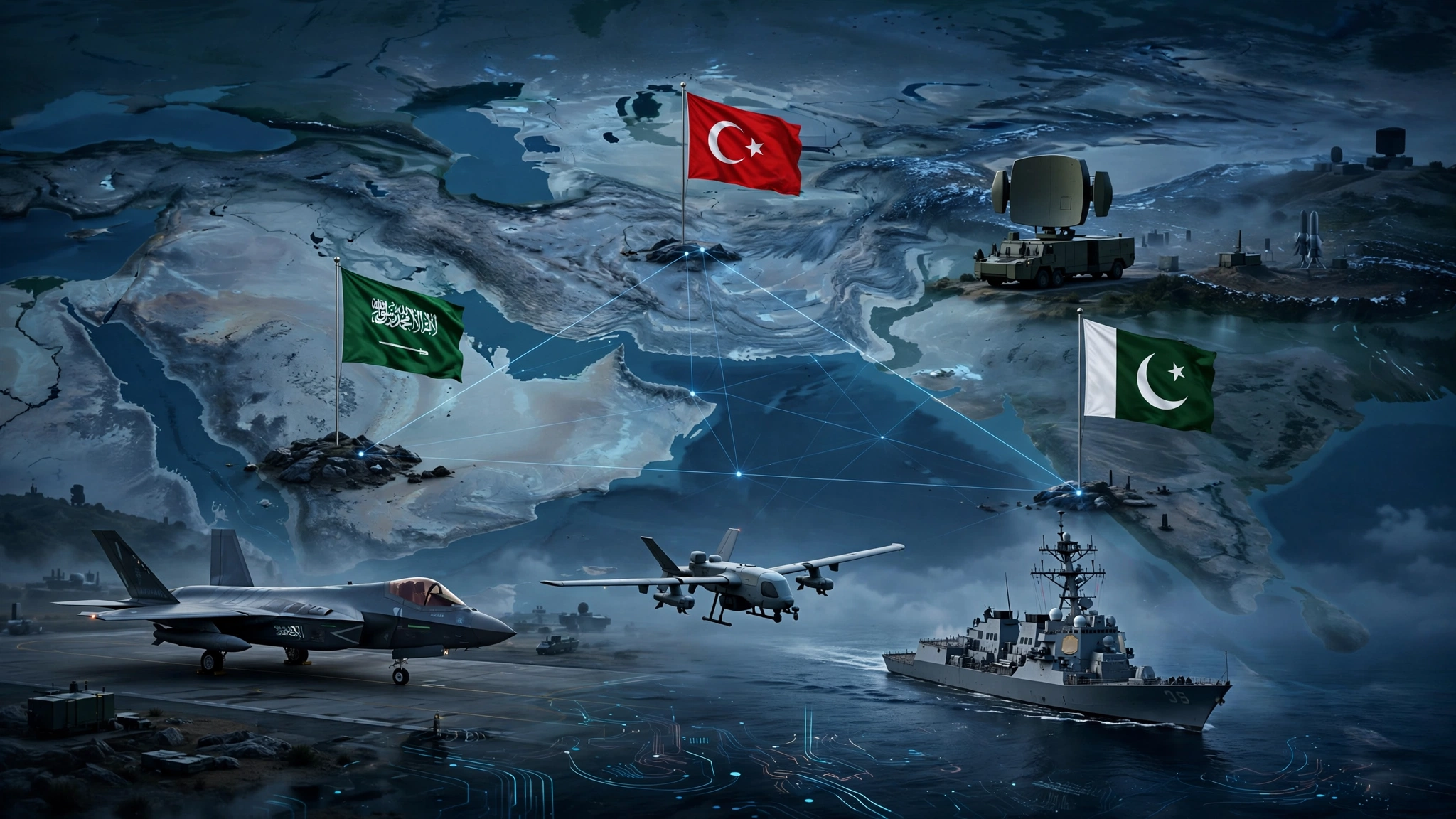
The Saudi Arabia-Türkiye-Pakistan defence pact could lead to higher military spending in all three countries, but it does not itself require a specific increase in defence budgets. Instead, the new collective-defence agreement could create strong incentives for greater investment in weapons, air defence, drones, intelligence, military infrastructure and joint defence production.
Saudi Arabia, Türkiye and Pakistan signed the Mecca Joint Defence Agreement in Makkah on August 7, 2026. The agreement establishes a collective-defence principle under which an armed attack against one member is considered an attack against all three. However, the pact does not publicly establish a fixed defence-spending target or automatic military response.
That distinction is important.
The real question is therefore not whether the treaty orders Pakistan, Saudi Arabia and Türkiye to spend more on their militaries.
It doesn't.
The more important question is whether the new security arrangement will encourage greater military investment.
The answer is probably yes.
Why Could the Defence Pact Increase Military Spending?
Collective defence requires more than a political declaration.
If Saudi Arabia, Türkiye and Pakistan want their new security partnership to provide credible deterrence, they will need military capabilities that can work together during a crisis.
That could require greater investment in:
- Air and missile defence
- Drones and counter-drone systems
- Intelligence and surveillance
- Secure communications
- Cybersecurity
- Naval capabilities
- Military transport
- Ammunition and logistics
- Joint military exercises
- Defence research and development
- Joint weapons production
The agreement therefore creates a strategic incentive for additional defence investment, even without imposing a formal spending requirement.
Reuters reported that the pact contains the collective-defence principle but lacks specific military commitments, meaning its practical strength will depend on how the three governments implement it.
Will Pakistan Increase Military Spending?
Pakistan is likely to be one of the most interesting cases.
Islamabad has strong strategic reasons to strengthen its military capabilities, particularly because Pakistan faces a complicated security environment involving India, Afghanistan and the wider regional situation.
However, Pakistan also faces significant economic and fiscal constraints.
For that reason, a massive across-the-board increase in military spending may be difficult.
A more realistic possibility is targeted defence investment.
Pakistan could prioritize capabilities that directly support collective defence with Saudi Arabia and Türkiye.
Air Defence and Missile Defence
Modern conflicts have demonstrated the importance of air and missile defence.
Pakistan could increase investment in:
- Air-defence systems
- Radar networks
- Early-warning capabilities
- Counter-drone technology
- Electronic warfare
- Integrated command-and-control systems
These capabilities would strengthen Pakistan's own security while also improving interoperability with its partners.
Drones and Unmanned Systems
Türkiye's growing drone industry could become particularly important.
Pakistan has already developed significant experience with unmanned systems, while Türkiye has emerged as a major international defence exporter.
The trilateral relationship could therefore encourage greater cooperation in:
- Armed drones
- Surveillance drones
- Counter-drone systems
- Autonomous platforms
- Drone warfare technology
Joint Defence Production
For Pakistan, joint production may be more important than simply increasing its defence budget.
Rather than purchasing every advanced system from foreign suppliers, Pakistan could work with Türkiye and Saudi Arabia on manufacturing and technology development.
Joint production could involve drones, ammunition, naval systems, electronic warfare equipment and other defence technologies.
This could help Pakistan improve military capability while managing financial constraints.
What About Saudi Arabia's Military Spending?
Saudi Arabia has much greater financial capacity than Pakistan and is already a major defence spender.
The new pact could encourage Riyadh to invest further in capabilities that strengthen its ability to defend itself and cooperate with Türkiye and Pakistan.
One major priority is likely to remain air and missile defence.
Saudi Arabia's geographical position and critical energy infrastructure make protection against missiles and drones particularly important.
The Kingdom could therefore increase investment in:
- Missile-defence systems
- Radar
- Counter-drone technology
- Electronic warfare
- Early-warning networks
- Air-defence command systems
Saudi Arabia could also expand defence procurement from Türkiye.
Could Saudi Arabia Buy More Turkish Weapons?
Potentially, yes.
Türkiye has developed a rapidly expanding defence industry involving drones, missiles, naval systems, aerospace technology and other military equipment.
A stronger Saudi-Turkish defence relationship could therefore produce more defence contracts and joint manufacturing projects.
This could benefit Türkiye economically while allowing Saudi Arabia to diversify its military suppliers.
The important point is that Saudi Arabia does not necessarily have to abandon American or European defence suppliers.
Instead, Riyadh could pursue a multi-supplier defence strategy.
That would give Saudi Arabia greater flexibility and potentially reduce dependence on any single external supplier.
Will Türkiye Increase Its Military Budget?
Türkiye's situation is different from Pakistan and Saudi Arabia.
Ankara has already invested heavily in developing its domestic defence industry.
The country has expanded production of:
- Drones
- Missiles
- Naval platforms
- Armoured vehicles
- Electronic-warfare systems
- Aerospace systems
- Air-defence technology
Therefore, the Saudi-Pakistan-Türkiye defence pact may produce more defence production and exports rather than simply causing a dramatic increase in Türkiye's overall military budget.
Saudi Arabia has the financial resources to become an important customer for Turkish defence companies.
Pakistan could also become a partner in joint development and manufacturing.
That creates the possibility of a powerful defence-industrial triangle.
Could Joint Defence Production Reduce Costs?
Interestingly, the pact could eventually help the three countries get more military capability without increasing spending proportionally.
Joint development can create economies of scale.
For example, instead of Pakistan, Saudi Arabia and Türkiye independently developing similar systems, they could cooperate on:
- Drones
- Missiles
- Naval systems
- Ammunition
- Cybersecurity
- Electronic warfare
- Military communications
- Maintenance and training
This could reduce duplication and improve interoperability.
For Pakistan in particular, joint production could be a way to modernize its military while reducing dependence on expensive foreign imports.
Military Exercises Will Also Cost Money
Another likely area of increased spending is joint military exercises.
If the collective-defence agreement is to become operationally meaningful, the three countries will need to practice working together.
That could include:
- Air-force exercises
- Naval exercises
- Special-forces training
- Air-defence exercises
- Counterterrorism exercises
- Cybersecurity exercises
- Search-and-rescue operations
- Intelligence coordination
These activities require aircraft, ships, fuel, ammunition, personnel, communications equipment and logistics.
Consequently, even if national defence budgets remain relatively stable, spending on interoperability could increase.
The Biggest Change May Be What They Spend Money On
The most important consequence of the Saudi Arabia-Türkiye-Pakistan defence pact may not be the size of military budgets.
It may be the direction of military spending.
The agreement could encourage investment in capabilities that make the three militaries more compatible.
For example, intelligence-sharing requires compatible communications and information systems.
Joint air defence requires compatible radar and command systems.
Joint operations require interoperable logistics and communications.
This means future defence spending could increasingly focus on:
Drones + air defence + missiles + intelligence + cyber + naval power + secure communications.
Could the Pact Trigger a Regional Arms Race?
This is one of the biggest risks.
If other countries interpret the new trilateral defence arrangement as a major shift in the regional balance of power, they may respond by increasing their own military capabilities.
The result could be a security dilemma.
One country increases military spending because it feels threatened.
Another country sees that buildup and responds with its own military investment.
The cycle could become:
Pakistan, Saudi Arabia and Türkiye strengthen defence capabilities
↓
India or Iran perceives greater strategic pressure
↓
India or Iran increases military investment
↓
The three pact members respond
↓
Regional defence spending rises further
This outcome is not inevitable.
A stronger defence partnership could also have the opposite effect if it successfully deters potential aggression.
If potential attackers believe that attacking one member could bring coordinated support from the other two, they may become less willing to initiate a conflict.
In that scenario, increased defence investment could contribute to deterrence rather than an arms race.
What Could the Pact Mean for India?
India is likely to closely monitor the military implications of the new agreement.
Pakistan and Türkiye already maintain close defence ties, while Saudi Arabia has substantial economic and diplomatic relations with India.
Therefore, the pact should not automatically be interpreted as an anti-India alliance.
However, India will likely pay attention to whether the agreement develops into a more integrated military partnership.
If Pakistan gains access to more Turkish technology, Saudi financial resources and coordinated intelligence support, India's strategic calculations could change.
India could respond by strengthening its own capabilities in areas such as:
- Air defence
- Drones
- Missiles
- Naval power
- Space surveillance
- Electronic warfare
But any significant increase in Indian defence spending would depend on the broader strategic environment rather than the pact alone.
What Could It Mean for Iran?
Iran is another major factor.
The three countries have not officially described the pact as an alliance against Iran.
Türkiye has emphasized that the agreement is defensive and is not directed against a particular country.
For Pakistan, this distinction is particularly important.
Pakistan shares a border with Iran and has important security and economic interests in maintaining stable relations with Tehran.
If tensions between Iran and Saudi Arabia increase, however, the new collective-defence framework could create difficult choices for Islamabad and Ankara.
A direct attack on Saudi Arabia would potentially test how far the collective-defence commitment actually goes.
That could influence future defence planning and military spending.
Does the Defence Pact Require Higher Military Budgets?
No.
This is perhaps the most important point to understand.
The publicly reported agreement does not establish a specific percentage of GDP or national budget that Pakistan, Saudi Arabia or Türkiye must allocate to defence.
It also does not automatically require the three governments to increase their military spending.
Therefore, it would be misleading to say:
«"The defence pact forces Pakistan, Saudi Arabia and Türkiye to increase military spending."»
A more accurate statement is:
«The pact could encourage higher and more strategically targeted defence investment because the members need credible capabilities to support their collective-defence commitment.»
That distinction makes the analysis more realistic.
Which Country Could Spend the Most?
The three countries have very different economic circumstances.
Saudi Arabia
Saudi Arabia has the greatest financial capacity to increase defence procurement.
Its likely priorities could include missile defence, drones, surveillance, electronic warfare and advanced military technology.
Türkiye
Türkiye may benefit through increased defence production, research and development and exports.
The agreement could create new markets for Turkish defence companies.
Pakistan
Pakistan may pursue more targeted modernization because of economic constraints.
Its priorities could include air defence, drones, missiles, intelligence, naval capabilities and joint production with Türkiye and Saudi Arabia.
Could the Pact Increase Defence Spending Beyond These Three Countries?
Possibly.
If the agreement significantly changes regional military calculations, other states could respond.
India could reassess its defence priorities.
Iran could strengthen its missile, drone and air-defence capabilities.
Other Gulf countries could also evaluate whether they need stronger security partnerships.
This means the agreement could have consequences far beyond the three signatories.
However, it is still too early to predict a specific regional spending increase.
What Should We Watch Next?
The most important indicators will not necessarily be announcements about defence budgets.
Instead, watch for concrete developments such as:
Joint military exercises
Are Pakistan, Saudi Arabia and Türkiye conducting more frequent exercises?
Joint procurement
Are the three countries purchasing military systems together?
Defence-industrial agreements
Are Turkish and Pakistani companies establishing manufacturing partnerships in Saudi Arabia?
Intelligence cooperation
Are new mechanisms being created for sharing military intelligence?
Air-defence integration
Are the three countries developing compatible radar, command and missile-defence systems?
Permanent military institutions
Does the new agreement develop permanent structures for coordination?
These developments will reveal whether the pact is becoming a genuine operational security partnership.
Final Verdict
So, will the Saudi Arabia-Türkiye-Pakistan defence pact increase military spending?
It could—and over the longer term, higher defence investment is a reasonable expectation. But the pact itself does not impose a specific military-spending increase.
For Pakistan, the likely focus will be targeted modernization, joint defence production and interoperability with Türkiye and Saudi Arabia.
For Saudi Arabia, the agreement could encourage additional procurement of advanced defensive systems and greater diversification of military suppliers.
For Türkiye, the biggest opportunity may be increased defence production, technology development and exports.
The most significant change could therefore be how the three countries spend their defence budgets rather than simply how much they spend.
The pact could shift attention toward capabilities that support collective defence: air and missile defence, drones, intelligence, cyber capabilities, naval security, secure communications and joint military infrastructure.
There is also a potential downside.
If neighboring countries interpret the new defence framework as a threat, it could contribute to a regional arms competition.
But if the agreement successfully strengthens deterrence, it could instead reduce the likelihood of major conflict by increasing the cost of attacking any one member.
For now, the best conclusion is that the Saudi Arabia-Türkiye-Pakistan defence pact creates an incentive for greater and more coordinated defence investment, but it does not guarantee a specific increase in military spending.
The real test will come from implementation.
If the three countries move toward joint exercises, intelligence sharing, integrated capabilities and defence-industrial cooperation, the financial impact could become substantial.
If the agreement remains primarily political, its effect on military budgets may be much smaller.
Either way, the pact marks an important development in the security relationship between South Asia, the Gulf and Türkiye, and its impact on regional defence spending will be closely watched in the years ahead.
- How Did the Cockroach Janta Party Start?The Cockroach Janta Party emerged in 2026 as a satirical online movement after controversy surrounding remarks perceived as insulting to unemployed youth. Using the cockroach as a symbol of resilience, it rapidly evolved from viral memes into a broader youth-led campaign focused on unemployment, exam paper leaks, and demands for greater government accountability.
- What Are the Emotional Challenges of Being Obese and Unmarried in Your 30s?Excerpt: What does it really feel like to be obese and unmarried in your 30s? In this honest, first-person article, a doctor shares the emotional challenges of low self-esteem, feeling left behind, and fear of judgment, while offering practical advice, hope, and motivation to improve both physical and mental well-being.
- How Can Someone Tell If Social Media Is Harming Their Mental Health?Discover the hidden signs social media may be harming your mental health. Learn practical tips, a relatable student story, and healthy habits to regain balance.
- Are All Nicotine Products Equally Harmful? A Cardiologist Explains the Science Behind the RisksAre all nicotine products equally harmful? Learn what science says about nicotine, cigarette smoke, combustion, and the real causes of smoking-related diseases in this evidence-based guide.
- Does Everyone Feel Jealous at Work? What's Normal?Feeling jealous at work is a normal human experience. Many people occasionally compare themselves to coworkers who receive promotions, recognition, or new opportunities. While these feelings can be uncomfortable, they don't necessarily indicate a problem. When acknowledged and managed constructively, jealousy can even highlight personal goals and motivate professional growth. However, if it becomes persistent, damages relationships, or interferes with work performance, it's important to address the underlying causes and seek support if needed.
Comments (0)
Please to leave a comment.