Raven vs Crow: How to Tell the Difference Easily
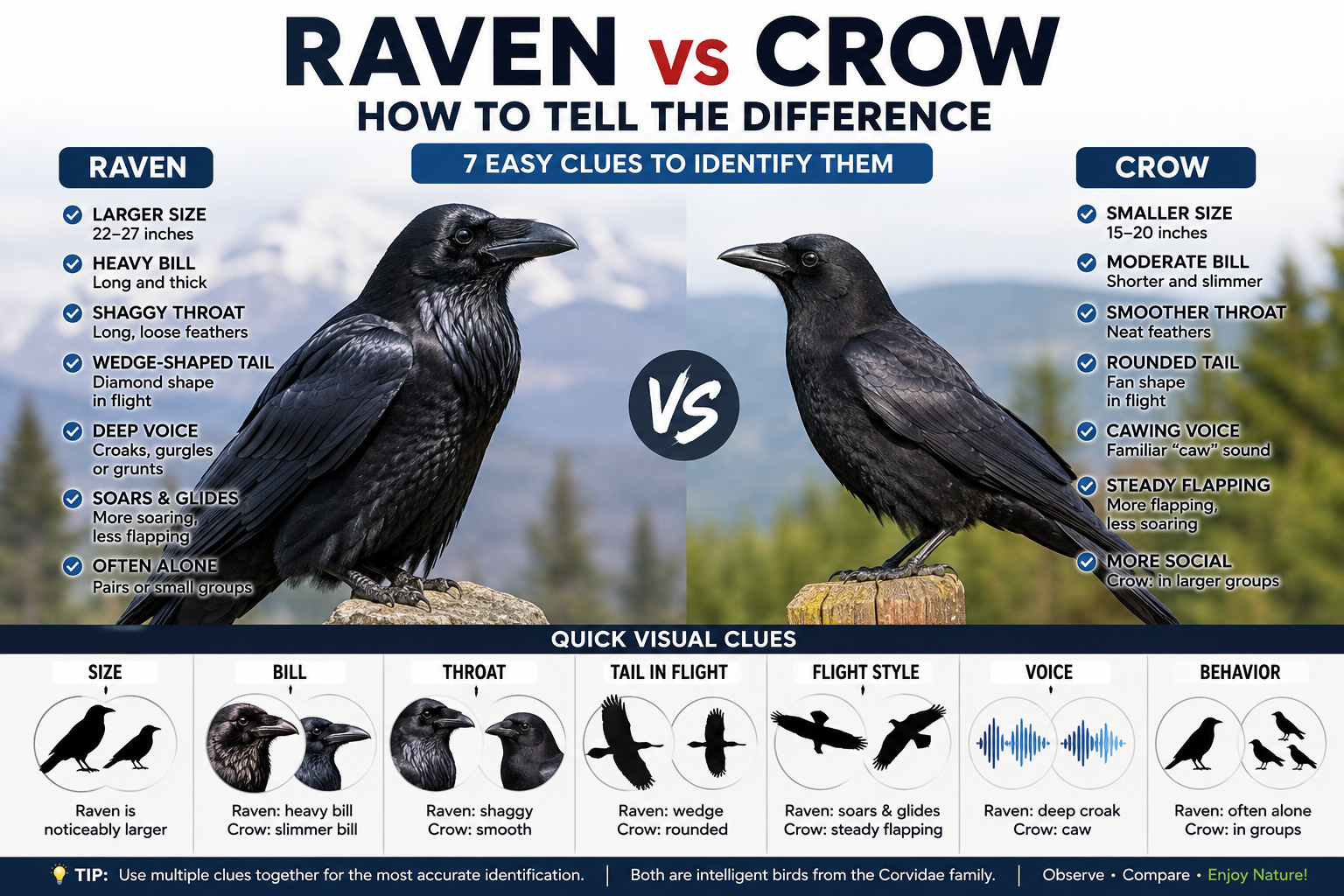
Have you ever looked at a large black bird and wondered, “Is that a raven or a crow?”
You're not alone. Ravens and crows are closely related members of the Corvidae family, and both can appear almost completely black at a quick glance. That makes them surprisingly easy to confuse.
The good news is that you don't need to be an expert birder to tell them apart.
By looking at a few key features—including size, bill shape, throat feathers, tail shape, flight style, and sound—you can usually make a confident identification.
Raven vs Crow: The Quick Answer
The easiest rule of thumb is:
Ravens are generally larger, heavier-billed birds with shaggy throat feathers and a wedge- or diamond-shaped tail. Crows are smaller, have a more moderate bill, smoother throat feathers, and a rounded or squared-looking tail.
Their voices are also different. Crows typically produce the familiar “caw,” while Common Ravens have a deeper, croaking or gurgling call.
But there is more to it than size.
Raven vs Crow: Side-by-Side Comparison
Feature Raven Crow Overall size Much larger Smaller Bill Large, heavy and powerful Smaller and more moderate Throat Long, shaggy feathers Smoother-looking Tail in flight Wedge- or diamond-shaped Rounded or squared Wings Longer and narrower Broader and shorter Flight Often soars and glides More steady flapping Voice Deep croak/gurgle Familiar caw Typical social behavior Often alone or in pairs, though exceptions occur Often more social Overall impression Massive and imposing Smaller and more compact
These characteristics are especially useful when comparing the Common Raven with the American Crow, two species that are frequently confused in North America.
1. Look at the Size
Size is one of the quickest clues.
A Common Raven is substantially larger than an American Crow. Cornell Lab lists the Common Raven at roughly 22–27 inches (56–69 cm) long, while the American Crow is around 20 inches.
A raven can have a surprisingly massive appearance—especially its head, neck, bill, and wings.
If the bird looks almost hawk-sized, particularly when viewed at close range, consider a raven.
However, don't rely on size alone. Different crow and raven species vary considerably, and judging size from a distant bird can be difficult.
2. Examine the Beak
The bill is another excellent clue.
A raven has a noticeably larger, heavier, more powerful-looking bill. It can appear almost oversized compared with the bird's head.
A crow's bill is generally more moderate in proportion.
If you can see the bird reasonably well, ask yourself:
“Does that beak look unusually large and heavy?”
If yes, a raven becomes more likely.
3. Check the Throat Feathers
This is one of the best clues when the bird is perched.
Common Ravens have distinctive long, shaggy throat feathers. The feathers around the throat can give the bird a rough, almost mane-like appearance.
Crows generally have a smoother-looking throat.
So if you're close enough to see the bird's neck clearly, don't just look at its color. Look at the texture of the feathers.
4. Look at the Tail While It Is Flying
This may be the most useful visual clue when a bird flies overhead.
A crow's tail generally looks rounded or squared when spread.
A raven's tail is more tapered and wedge-shaped, producing a distinctive diamond-like appearance in flight. This happens because the central tail feathers extend farther than the outer feathers.
Easy memory trick:
Crow = fan
Raven = wedge
If you see a large black bird flying overhead, pay attention to the shape of the tail rather than simply its color.
5. Watch How It Flies
Ravens and crows don't always fly in exactly the same way.
Common Ravens have long wings and are particularly comfortable soaring and gliding, sometimes using rising air currents.
Crows tend to rely more on steady, active wingbeats.
Cornell notes that Common Ravens have a buoyant flight style that combines soaring, gliding, and slower wingbeats, while American Crows tend to flap more steadily.
So if that enormous black bird seems to be effortlessly riding the air, a raven is worth considering.
6. Listen to the Call
Sometimes the best way to identify a raven or crow is simply to listen.
An American Crow produces the familiar harsh “caw.”
A Common Raven's voice is generally much deeper and can sound like a croak, gurgle, or low rasp.
Cornell describes the Common Raven's classic vocalization as a deep, gurgling croak that differs noticeably from the scratchier sound of a crow.
Think of it this way:
Crow → “Caw!”
Raven → deep “croak/gurgle”
Learning the sounds can be especially helpful when vegetation or distance makes visual identification difficult.
7. Consider Behavior and Social Habits
Behavior can provide another useful clue, although it should never be your only identification method.
Common Ravens are frequently encountered alone or in pairs, while American Crows are often more social and may gather in larger groups or communal roosts.
But there are important exceptions.
Ravens can gather around abundant food sources, and some raven species are quite social. For example, Chihuahuan Ravens can occur in flocks.
Therefore:
“It's alone, so it must be a raven” is not a reliable rule.
Use behavior as one clue among several.
Raven vs Crow: What Does Each Bird Look Like?
What Does a Raven Look Like?
A Common Raven typically has:
A large, powerful body
A very heavy bill
Long, shaggy throat feathers
Long, relatively narrow wings
A wedge-shaped tail in flight
A deep, croaking voice
A strong soaring and gliding flight style
It often gives an overall impression of being large, heavy, and imposing.
What Does a Crow Look Like?
An American Crow typically has:
A smaller body
A moderate-sized bill
A smoother throat
Broad wings
A rounded or squared tail in flight
A familiar cawing voice
More frequent steady flapping during flight
Crows are also highly adaptable and can commonly be found around fields, roadsides, towns, cities, and other human environments.
The 10-Second Raven vs Crow Test
If you only have a few seconds to identify the bird, use this checklist:
Step 1: How big is it?
Huge? Think raven.
Step 2: How big is the bill?
Very large and heavy? Raven becomes more likely.
Step 3: What does the tail look like?
Wedge-shaped? Raven.
Rounded or squared? Crow.
Step 4: How does it fly?
Soaring and gliding? Raven.
Steady flapping? Crow.
Step 5: What does it sound like?
Deep croak/gurgle? Raven.
Classic caw? Crow.
The more clues that agree, the more confident you can be.
Can You Tell a Raven From a Crow by Color?
Usually, no.
Both can appear entirely black, so color is not a particularly useful distinguishing feature.
Instead, pay attention to shape and structure.
In fact, one of the biggest mistakes beginners make is staring at the bird's feathers and thinking:
“It's black, so it's probably a crow.”
Black plumage tells you very little here.
The bird's silhouette, proportions, tail, bill, and voice are much more informative.
Raven vs Crow: The Biggest Mistake to Avoid
Don't identify the bird based on one feature alone.
For example, a bird being large does not automatically make it a raven. A bird being in a group doesn't automatically make it a crow.
This matters because there are multiple crow and raven species around the world, and their appearance and behavior can overlap.
The safest approach is to combine several characteristics.
Size + bill + throat + tail + flight + voice = much more reliable identification.
Cornell specifically notes that crows and ravens can be tricky to identify because multiple species exist, and vocalizations can be especially useful for distinguishing them.
Are Ravens and Crows the Same Bird?
No.
Ravens and crows are different birds, although both belong to the same family, Corvidae.
They are close relatives, which helps explain why they can look so similar.
The term “crow” can also refer to several different species, just as “raven” can refer to more than one species. Therefore, the exact identification depends partly on where you are and which species occur in that region.
Why Are Ravens and Crows So Difficult to Tell Apart?
The simple answer is that they're closely related and share many characteristics.
Both are intelligent corvids. Both can be black. Both are adaptable omnivores. Both can live around humans. And both have similar general body plans.
That's why identification becomes much easier when you stop asking:
“Is this bird black?”
and start asking:
“What does this bird's shape, flight, tail, bill, and voice tell me?”
Frequently Asked Questions
Is a raven bigger than a crow?
Yes. The Common Raven is substantially larger than the American Crow and has a heavier bill and longer wings.
Do ravens and crows have different tails?
Yes. A Common Raven's tail is typically wedge- or diamond-shaped in flight, while an American Crow's tail appears more rounded or squared.
Which has the deeper voice, a raven or a crow?
The Common Raven generally has the deeper voice. Its calls can sound like low croaks or gurgles, while crows are famous for their harsher cawing calls.
Are ravens smarter than crows?
Both ravens and crows are highly intelligent birds. It is better not to reduce their intelligence to a simple “which is smarter?” comparison because intelligence varies across species and across different cognitive tasks.
Can a crow be as large as a raven?
Some crow species can be quite large, and some raven species are smaller than the Common Raven. That's why geographic location and multiple identification features matter.
What is the easiest way to remember the difference?
Remember:
RAVEN = BIG, HEAVY BILL, SHAGGY THROAT, WEDGE TAIL
CROW = SMALLER, MODERATE BILL, SMOOTHER THROAT, ROUNDED TAIL
Final Verdict: Raven or Crow?
When trying to identify a mysterious black bird, don't focus on color.
Instead, look at the whole bird.
A large body, heavy bill, shaggy throat, long wings, wedge-shaped tail, soaring flight, and deep croaking call point toward a raven.
A smaller body, moderate bill, smoother throat, rounded or squared tail, steady flapping, and familiar cawing call point more toward a crow.
And remember: these are identification clues, not absolute rules. Different species can overlap in size, behavior, habitat, and appearance.
The more features you observe together, the better your identification will be.
Next time you see a black bird overhead, don't just ask “crow or raven?” Look at the tail, listen to the voice, check the bill—and you may be surprised by what you've been seeing.
- What Are the Emotional Challenges of Being Obese and Unmarried in Your 30s?Excerpt: What does it really feel like to be obese and unmarried in your 30s? In this honest, first-person article, a doctor shares the emotional challenges of low self-esteem, feeling left behind, and fear of judgment, while offering practical advice, hope, and motivation to improve both physical and mental well-being.
- How Did the Cockroach Janta Party Start?The Cockroach Janta Party emerged in 2026 as a satirical online movement after controversy surrounding remarks perceived as insulting to unemployed youth. Using the cockroach as a symbol of resilience, it rapidly evolved from viral memes into a broader youth-led campaign focused on unemployment, exam paper leaks, and demands for greater government accountability.
- Does Everyone Feel Jealous at Work? What's Normal?Feeling jealous at work is a normal human experience. Many people occasionally compare themselves to coworkers who receive promotions, recognition, or new opportunities. While these feelings can be uncomfortable, they don't necessarily indicate a problem. When acknowledged and managed constructively, jealousy can even highlight personal goals and motivate professional growth. However, if it becomes persistent, damages relationships, or interferes with work performance, it's important to address the underlying causes and seek support if needed.
- Did a Japanese Millionaire Really Turn Into a Dog? The Truth Behind the Viral Story and Why People Believe ItDid a Japanese millionaire really turn into a dog? Discover the truth behind the viral Toco story, his realistic dog costume, AI misinformation, and why people believed it.
- PIMS Hospital Fire: Did Media Coverage Turn Doctors and Nurses Into Scapegoats?The PIMS hospital fire tragedy raises serious questions about media sensationalism, hospital safety, accountability, and the unfair targeting of doctors and nurses.
Comments (0)
Please to leave a comment.