PIMS Hospital Fire: Did Media Coverage Turn Doctors and Nurses Into Scapegoats?
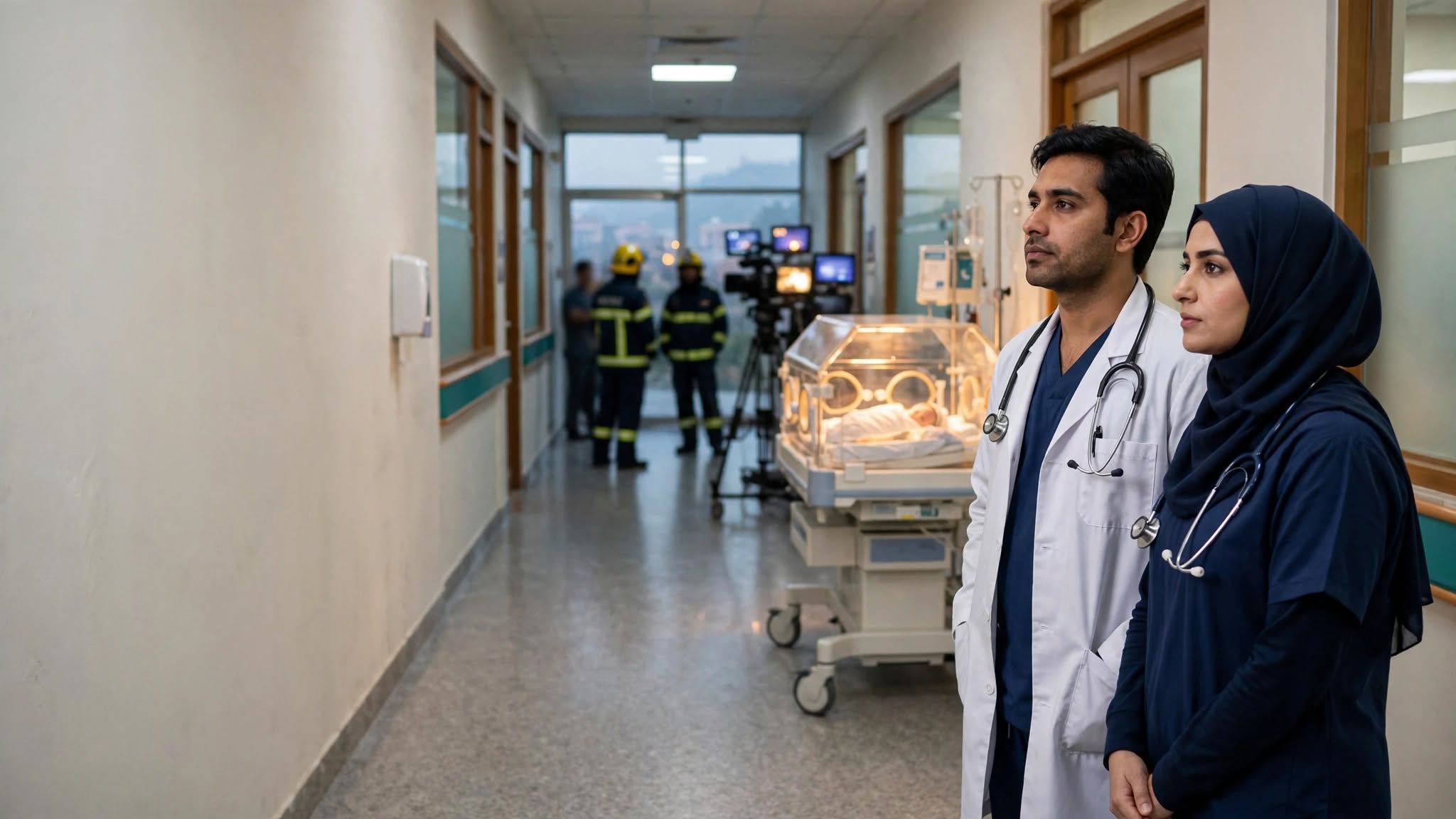
The PIMS hospital fire incident in Islamabad has left Pakistan deeply shocked. The reported deaths of newborn babies in a hospital nursery represent an unimaginable tragedy for the affected families and raise serious questions about hospital safety, emergency preparedness and accountability.
There must be a thorough and transparent investigation.
But there is another issue that deserves attention: the role of the media in shaping public perception during a tragedy.
When a disaster occurs, people naturally want answers. They want to know what happened, who was responsible and whether the tragedy could have been prevented.
The media has an important responsibility in providing those answers.
However, when headlines become sensational, allegations are presented as facts, or individual healthcare workers are blamed before an investigation is complete, journalism can unintentionally—or sometimes deliberately—turn grief into anger and anger into scapegoating.
The PIMS tragedy should not become an excuse to attack doctors and nurses who were working at the bedside.
At the same time, genuine negligence must never be protected.
The question is not whether there should be accountability. The question is: who should be held accountable, and on what evidence?
What Happened in the PIMS Hospital Fire?
The fire occurred in the Mother and Child Hospital at Pakistan Institute of Medical Sciences (PIMS), Islamabad, with reports stating that 14 newborn babies died.
Initial reports attributed the fire to an air-conditioning unit. However, subsequent reporting indicated that the exact source of the fire had not yet been conclusively established, with other possibilities including electrical wiring and problems involving the oxygen infrastructure being examined.
This is precisely why early media reporting needs caution.
A preliminary explanation is not necessarily a confirmed finding.
When an investigation is ongoing, responsible journalism should use terms such as:
“initial reports suggest”
“officials are investigating”
“the suspected cause”
“the cause has not yet been confirmed”
rather than presenting an early theory as the final answer.
The distinction may appear small, but it can completely change how the public perceives an incident.
The Media Has a Responsibility During a Tragedy
In a tragedy involving newborn deaths, emotions are understandably intense.
Parents are grieving. Families are angry. The public wants justice.
This is precisely when journalism should become more careful—not more sensational.
News organizations have the ability to influence millions of people within minutes through television headlines, social media clips, thumbnails and breaking-news banners.
A headline can create a perception of guilt long before investigators establish the facts.
Once that perception becomes viral, correcting it is extremely difficult.
The first version of a story often becomes the version people remember.
How Doctors and Nurses Become Soft Targets
Doctors and nurses are among the most visible people inside a hospital.
When a patient deteriorates, they are standing at the bedside.
When a tragedy occurs, cameras naturally look for them.
But the person visible at the bedside is not necessarily the person responsible for the infrastructure surrounding that bedside.
Hospital safety depends on a much larger system involving:
hospital administration
electrical maintenance
oxygen systems
fire alarms
emergency exits
evacuation protocols
fire extinguishing systems
staff training
disaster preparedness
regulatory inspections
government health administration
If a hospital has an infrastructure failure, it is simplistic to automatically attribute that failure to the doctor or nurse treating the patient.
A doctor cannot personally maintain the hospital's electrical wiring.
A nurse cannot personally design the fire-safety system.
A pediatrician cannot personally install the oxygen pipeline.
And a junior doctor cannot single-handedly determine the hospital's disaster-preparedness budget.
That does not mean healthcare professionals should never be held accountable.
It means responsibility should be established through evidence.
Doctors Are Not Firefighters
One of the most important points missing from some public discussions about hospital fires is the difference between medical emergency response and fire-rescue operations.
Doctors and nurses are trained to manage medical emergencies.
They are trained in:
neonatal resuscitation
airway management
CPR
ventilation
shock
seizures
medication emergencies
critical care
They are not professional firefighters.
Consider the environment inside a neonatal nursery during a major fire.
There may be:
rapidly spreading flames
dense smoke
extremely poor visibility
oxygen equipment and pipelines
electrical equipment
incubators and monitors
critically ill premature babies
limited routes of evacuation
Entering an uncontrolled fire without appropriate protective equipment and fire-rescue training can be fatal.
Therefore, the question should not simply be:
“Why didn't the doctors run into the fire?”
A much more meaningful question is:
“Was the hospital properly prepared to evacuate critically ill newborns during a fire?”
That question leads directly toward prevention.
Doctors and Nurses May Also Be at Risk
It is easy to judge an emergency from a television screen.
It is completely different to stand inside a burning hospital.
A healthcare worker who attempts to enter a smoke-filled or rapidly burning nursery may himself or herself become incapacitated within seconds.
This does not mean that healthcare workers have no responsibility during a fire.
They absolutely have emergency responsibilities.
But those responsibilities must be understood within the limits of their training, available equipment, evacuation procedures and the actual conditions at the scene.
Expecting doctors and nurses to behave like trained firefighters is neither medically nor operationally reasonable.
Oxygen and Fire: Why Context Matters
Another issue requiring proper explanation is oxygen.
Critically ill newborns frequently require supplemental oxygen.
Oxygen itself is not a fuel and does not independently start a fire. However, an oxygen-enriched environment can significantly increase the intensity and speed of combustion once an ignition source is present.
That is why oxygen-rich clinical environments require strict fire-safety precautions.
A complicated interaction involving:
ignition source + oxygen enrichment + combustible material
cannot responsibly be reduced to a simplistic television headline.
This is where journalists should consult both medical professionals and fire-safety experts.
The public deserves an explanation—not speculation.
Sensational Headlines Can Become a Second Disaster
The physical fire may last minutes.
The consequences of a sensational media narrative can last for years.
Imagine a headline suggesting that doctors were responsible for the deaths before an investigation had established what happened.
Millions of people see it.
Social-media users begin commenting.
Doctors are called negligent.
Nurses are abused.
Families become more angry.
Politicians make statements.
Then, weeks or months later, an investigation discovers that the major problem involved infrastructure, administration or a systemic safety failure.
Can the original damage be undone?
Usually not.
The headline has already travelled much further than the correction.
A Personal Example: When Clinical Medicine Looks Different on Camera
As a doctor, I have personally seen how easily a medical procedure can be misunderstood when removed from its clinical context.
A video once circulated showing a doctor applying a painful stimulus over the sternum of a female patient.
The video was portrayed by sections of the media as inappropriate behaviour.
The doctor subsequently became the target of a large number of negative comments.
But there was an important medical context that was missing from the viral presentation.
A painful stimulus can be used during assessment of responsiveness in an unconscious or poorly responsive patient, including neurological assessment such as the Glasgow Coma Scale (GCS).
A viewer unfamiliar with clinical medicine may see something completely different from what a trained doctor sees.
That example demonstrates a broader problem:
A short video does not necessarily contain the clinical context required to judge a medical action.
Before accusing a healthcare professional of misconduct, the media should ask qualified medical professionals what they are actually seeing.
The Problem With Judging Before the Investigation
There is a fundamental difference between investigation and judgment.
An investigation asks:
What happened?
A responsible investigation then asks:
Why did it happen?
And finally:
Who was responsible?
Sensational media coverage can reverse this process:
Who can we blame?
That is dangerous.
If an individual doctor is genuinely responsible for negligence, evidence should establish it.
If a nurse violated a critical safety protocol, investigate it.
But if the root cause is an administrative failure, infrastructure problem or inadequate fire-safety system, blaming the frontline healthcare worker does not solve anything.
Where Is the Health Administration in the Conversation?
This is perhaps the most important question.
When hospital infrastructure fails, why does public attention so quickly move toward doctors and nurses?
Who is responsible for:
fire-safety inspections?
electrical maintenance?
emergency exits?
fire alarms?
sprinkler systems?
oxygen infrastructure?
evacuation planning?
disaster drills?
hospital safety audits?
maintenance contracts?
regulatory compliance?
These are primarily system-level questions.
Frontline doctors and nurses work within systems designed and managed by larger institutions.
Therefore, accountability should not stop at the bedside.
It should move upward through the administrative structure.
Political Point-Scoring Can Make the Problem Worse
Healthcare tragedies can quickly become political.
That is understandable because health systems are ultimately connected to government policy and administration.
But political debate should focus on improving the system rather than finding a convenient individual to blame.
There is also a concern that frontline healthcare workers can become political shields.
Administrative failures are complicated.
They involve budgets, procurement, maintenance, regulations, inspections and institutional decision-making.
Those subjects are difficult to explain in a 30-second television segment.
Blaming a doctor is much easier.
It produces a recognizable face.
It generates emotional reactions.
And it can divert attention away from deeper questions.
This is an opinion and should be treated as such—but it is an important question for Pakistani healthcare journalism:
Are we sometimes blaming the person standing in front of the broken system instead of examining who allowed the system to become broken?
Accountability Is Necessary—but It Must Be Evidence-Based
Defending doctors and nurses does not mean opposing accountability.
Quite the opposite.
Healthcare professionals should be held to high standards.
If an investigation finds genuine negligence, appropriate action should follow.
But accountability must be:
Evidence-based.
Individualized.
Transparent.
Fair.
And it should include every level of responsibility.
If the problem is an individual clinical error, address it.
If the problem is hospital administration, address it.
If the problem is inadequate infrastructure, address it.
If regulatory authorities failed, investigate them.
If the health system itself has weaknesses, fix them.
What Responsible Media Coverage Should Have Done
During a tragedy such as the PIMS hospital fire, responsible media coverage should follow several principles.
1. Verify Before Accusing
Allegations should not be presented as established facts.
2. Distinguish Facts From Theories
If the cause of the fire has not been established, the audience should be told exactly that.
3. Consult Medical Experts
Medical procedures and emergency responses should be explained by qualified professionals.
4. Consult Fire-Safety Experts
Hospital fires require technical understanding.
5. Investigate the Entire System
Don't focus exclusively on the healthcare worker visible on camera.
6. Avoid Sensational Headlines
The purpose of a headline should be to inform—not provoke hatred.
7. Protect Grieving Families
Grief should not become television entertainment.
8. Give Healthcare Workers a Fair Opportunity to Respond
Accusations should not become verdicts.
9. Follow the Investigation
If early information changes, media outlets should prominently update their audience.
10. Focus on Prevention
The ultimate purpose of investigating a tragedy should be preventing another one.
The Public Deserves Truth, Not a Villain
The families who lost their babies deserve answers.
They deserve justice.
They deserve transparency.
And they deserve a hospital system where such a disaster is far less likely to happen again.
But justice does not mean immediately finding someone to blame.
Justice means finding out what actually happened.
The PIMS hospital fire should therefore trigger difficult questions about hospital infrastructure, fire preparedness, emergency evacuation, oxygen safety, administration and regulatory oversight.
And if individual healthcare workers are found responsible for negligence, they should face appropriate consequences.
But until the facts are established, doctors and nurses should not automatically become the soft targets of public anger.
Conclusion: Demand Accountability From the Right People
The PIMS hospital fire is a tragedy that should never be reduced to a television headline.
Fourteen newborn lives represent fourteen families whose lives have been permanently changed.
The appropriate response is not to suppress criticism.
It is to make criticism accurate, evidence-based and directed at the right level of responsibility.
Doctors and nurses should not be above the law.
But neither should hospital administrations, health authorities or regulatory systems.
Demand accountability—but demand it from the right people.
Before blaming the doctor at the bedside, ask who was responsible for the system surrounding that bedside.
Before sharing a sensational headline, ask whether the claim has actually been established.
Before judging a healthcare worker from a short video, ask what the medical context was.
And before turning a tragedy into a political battle, ask whether the argument is actually helping to make hospitals safer.
The PIMS tragedy should not simply produce a villain.
It should produce answers, accountability and reform.
Because the greatest tribute we can give to the babies who died is not another viral headline.
It is making sure that the next newborn admitted to a hospital is protected by a safer system.
- Will Saudi Arabia-Türkiye-Pakistan Defence Pact Increase Military Spending?Will the Saudi Arabia-Türkiye-Pakistan defence pact increase military spending? Explore its impact on defence budgets, weapons, joint production and regional security.
- Why Did Pakistan Hockey Decline From World Champion to Struggling? The Real Reasons Behind the DownfallWhy did Pakistan hockey decline from a world champion to a struggling team? Explore the role of artificial turf, governance, grassroots development, coaching, sports science and the collapse of the departmental system.
- What Are the Emotional Challenges of Being Obese and Unmarried in Your 30s?Excerpt: What does it really feel like to be obese and unmarried in your 30s? In this honest, first-person article, a doctor shares the emotional challenges of low self-esteem, feeling left behind, and fear of judgment, while offering practical advice, hope, and motivation to improve both physical and mental well-being.
- How Did the Cockroach Janta Party Start?The Cockroach Janta Party emerged in 2026 as a satirical online movement after controversy surrounding remarks perceived as insulting to unemployed youth. Using the cockroach as a symbol of resilience, it rapidly evolved from viral memes into a broader youth-led campaign focused on unemployment, exam paper leaks, and demands for greater government accountability.
- Does Everyone Feel Jealous at Work? What's Normal?Feeling jealous at work is a normal human experience. Many people occasionally compare themselves to coworkers who receive promotions, recognition, or new opportunities. While these feelings can be uncomfortable, they don't necessarily indicate a problem. When acknowledged and managed constructively, jealousy can even highlight personal goals and motivate professional growth. However, if it becomes persistent, damages relationships, or interferes with work performance, it's important to address the underlying causes and seek support if needed.
Comments (0)
Please to leave a comment.